A SPLITTING AXE IS A PRY…NOT A WEDGE
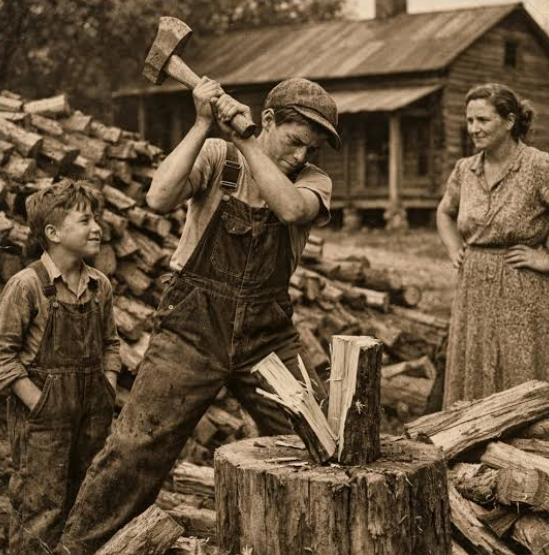
(Note from the editor: While this blog post is not really related to the beauty of Ontario barns, I believe many barn lovers also have an appreciation for the capable handling of an axe … and it ’tis the season for those of us heating with wood!)
By Will Samis, OBP Director, Ironbridge, (historic photos added by Jim Campbell)
He was not a large or powerful man but, boy-oh-boy, could he split wood. When he and his missus, my grandmother, sold up in Saskatchewan in 1926 and moved back to Ontario to retire among family near Warkworth, Ontario, the only tools he kept from the auctioneer’s gavel and brought back to Ontario with him were three axes. Two were what he would call limbing axes and one was a splitting axe. They were probably Walters or Welland-Vale axes. The limbing axes had shorter ash handles at about 26 inches and were smaller and lighter, the head weighing about 2 1/2 pounds. The splitting axe almost certainly had an ash handle that was 28 inches or over in length and a head that weighed 3 1/2 pounds plus. That 3 1/2 lbs when swung Grandpa’s way was a powerful wood splitting tool. He was 65 then, having been born 7 years before Canada became a nation and had been a farmer and farmer’s son all his life. I remember him cradling the outside round of a wheat field so the tractor wouldn’t drive on the unharvested wheat when the binder was brought into the field.
I never remember him working up a sweat or getting out of breath as he worked on our farm. He worked with an effortless steady elegant rhythm that spoke of a lifetime of repetitive farm work from jack-planting corn, to scything hay, to cradling wheat, to hoeing turnips, to hand milking cows to flailing bags of dry beans on the threshing floor or splitting firewood. He lived with us on my parents’ farm on Ridge Road north of Colborne and was often the built-in baby-sitter when I was very young. It was a task that he apparently adored and all 4 of us siblings reciprocated that affection.
I recall once being outside our house near the woodpile and chopping block when Dad drove into the yard with Grandpa as passenger.
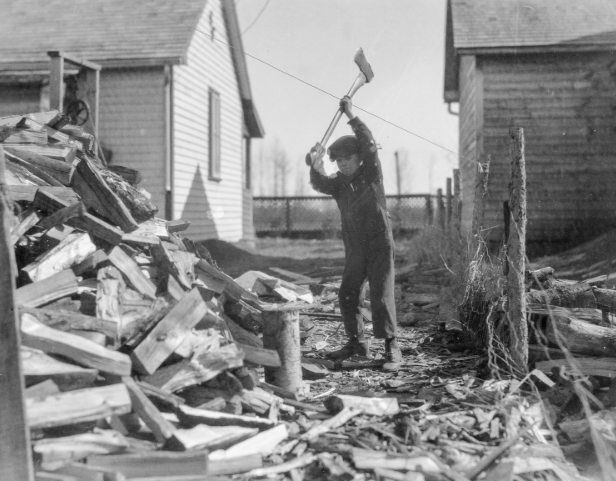
They had just come from Colborne where Grandpa had an appointment with Dr.Iles. Dad promptly went into the house while Grandpa came over to where I stood, removed and folded his vest, laying it neatly on the corner of the cement step. He then withdrew the splitting axe from the chopping block and started splitting firewood with that effortless swing of his. It was 4 to 6 inch diameter hardwood that we had cut out of fence-rows on our farm, our normal source of firewood, as our farm woods was pine and that was not the best for cooking or cold winter nights. Soon the screen door opened and my Dad stuck his head out and said “Dr. Iles said you should only do light work.” The reply wasn’t long in coming. “If you think this is heavy work , why then, I feel sorry for you.” Dad retreated and grandpa carried on splitting while wearing a white dress shirt, black suspenders, silvery sleeve lifters and a pocket watch, chain dangling.
Grandpa (Willis Samis) lived to be 92 and a couple nights before he passed Dr.Iles made a housecall as Grandpa wasn’t feeling well and had decided to stay in bed all day. Doc Iles reported to my parents after examining Grandpa in his bedroom that Grandpa had said “Doc, even if I died tonight…I’ve been a lucky man”. “I’m 92, I’ve never been in a hospital, I’ve never had a headache and I’ve never gone to bed hungry.” He lasted a couple days.
Now back to the axes. By anybody’s standards Grandpa, I believe, would be called a competent axeman.
Sometime in the year before he died, he undertook to teach me the art of splitting wood as he knew it. I had imagined myself becoming an axeman like my hero Grandpa, but my efforts at the chopping block were wild and dangerous and produced more broken handles and stuck axes than split wood.
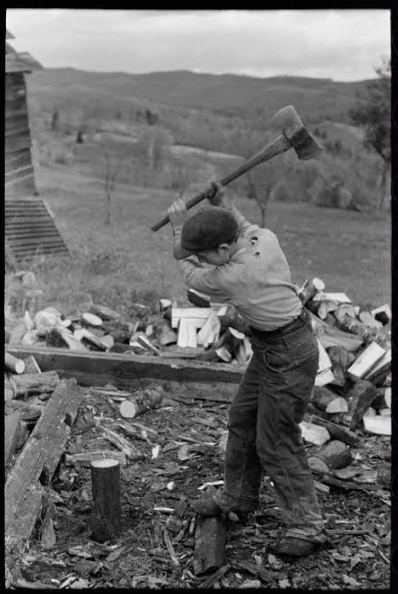
He started the lesson by taking the axe from me and carefully and patiently picked up an easy-to- split block and setting it on the chopping block … and yes that block did double duty when it was time to sacrifice a chicken. He swung the axe … seemingly slow, and the block flew apart with a loud whack. He was softspoken and no one ever heard him swear … a good teacher’s temperament.
His explanation … his lesson, on using the splitting axe, goes something like this:
Most folks use the axe as a wedge … powering it down though the wood causing the wood to separate into two pieces because the axe is thicker at the back than at the sharp face.
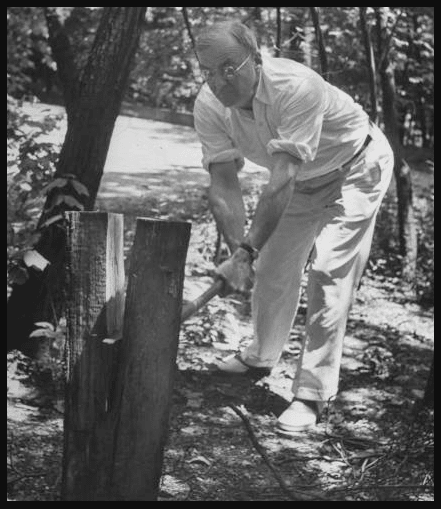
His alternative technique that he was taught and practised was using the axe as a pry rather than as a wedge. He patiently explained that most of the axe’s weight was above or behind where the handle attached. So the most efficient splitting technique was to make use of that weight by swinging the axe so that the sharp face went a half inch or so into the end-grain of the block and at the same time flick the axe so that it laid down flat on top of the block. That was the tricky part … not easily mastered the first few times. As the heavy back-end of the axe head, the poll or butt, lay down with a loud wack, the half inch already sticking into the endgrain exerted tremendous pressure prying the wood apart.
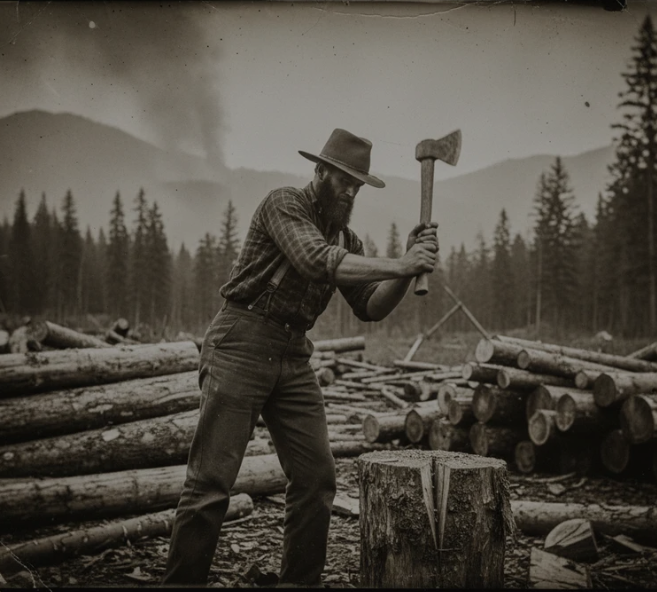
When Grandpa split wood the two halves of the block would fly apart and the axe would never even touch the chopping block or, heaven forbid, the ground. I slowly came to understand that his technique allowed the heavy end of the axe head to do the hard work of splitting … rather than the man swinging the axe.
Over the 7 decades since that lesson, I have broken a few axe handles and got a few axes stuck in both the block to be split and the chopping block and even hit the ground … but mostly I have mastered Grandpa’s technique and continued to use it … almost exclusively. I have taught it to a few others but monster mauls and hydraulic woodsplitters seem to have largely replaced the simple and efficient physics of Grandpa’s method. Those mauls … well now … they are heavy work.
To all OBP blog readers: If you have not already done so, please support not-for-profit, volunteer-run, Ontario Barn Preservation by becoming a member! Also, if you are in the business of repairing, reconstructing, engineering, designing, etc. old barns, please consider advertising your amazing skills on our Barn Specia-List. If you own an old barn that you would like to offer to someone else, or you are hoping to obtain one for your own project, make use of our Barn Exchange page. If you own an old barn and would like to save it in the virtual world for future old barn lovers, historians and researchers, check out our Your Old Barn Study page. And please send us your own barn story, photos and/or art for submission as a OBP blog posting for the enjoyment and education of all barn lovers! info@ontariobarnpreservation.com
Share this:

Discover more from Ontario Barn Preservation
Subscribe to get the latest posts sent to your email.