Roy’s Toys: Preserving a Perth County childhood
By OBP member Mel Luymes, Editor of The Rural Voice
(This story, first published in The Rural Voice in July of 2025 , is presented here with additional photos thanks for the generousity of Mel Luymes and Roy Berfelz)
PART 2 of 2 (at the end of Part 1 we left off when Roy has dove into painting and detailing the model of his grandfather’s barn…)
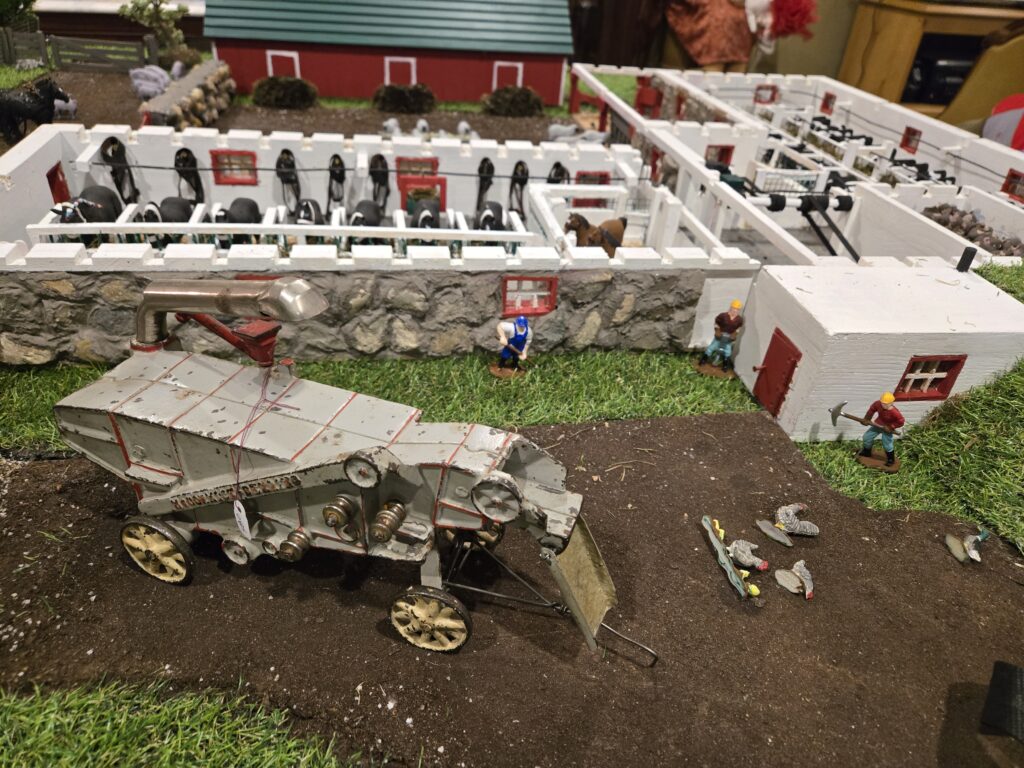
The roof and hay mow pulls away and there are animals in their stalls: Percheron draft horses in the newer part of the barn, and 18 Holstein cows and 16 heifers in the older part, each one 3D printed and hand-painted. The bull is in another part of the barn so there isn’t any “hanky-panky,” he laughs.
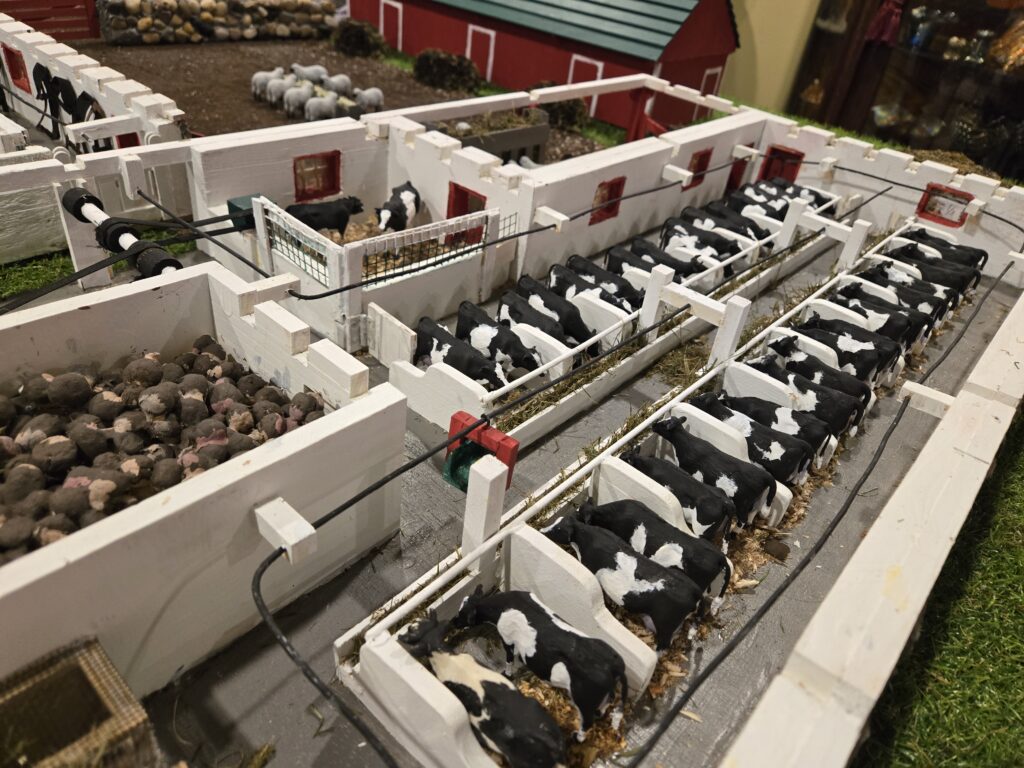
There are harnesses on the wall, and a storage room full of mangles that he rolled by hand from the original playdough recipe: flour, salt and water. Roy has keen memories of hand cranking the root pulper over the lunch hour to feed mangles to the cows, as well as milking the cows by hand when he was young. They cows would be on pasture for the summer and his grandfather’s dog would bring them in twice a day for milking. If Roy’s grandfather even mentioned cows, the dog would run off to get them, he says. Or he would just call “Cobass,” and they would all come running.
“I brought the model barn to our antique tractor club banquet last fall,” says Roy. “One guy he looked at me says that’s not right, you’ve got to have bedding, and you’ve got to have some manure.” So, Roy glued some woodchips in the stalls, poured little puddles of varnish, and made some cowpies from playdough as well. He installed a litter carrier, which is what they used to take manure out of the barn before stable cleaners were installed.
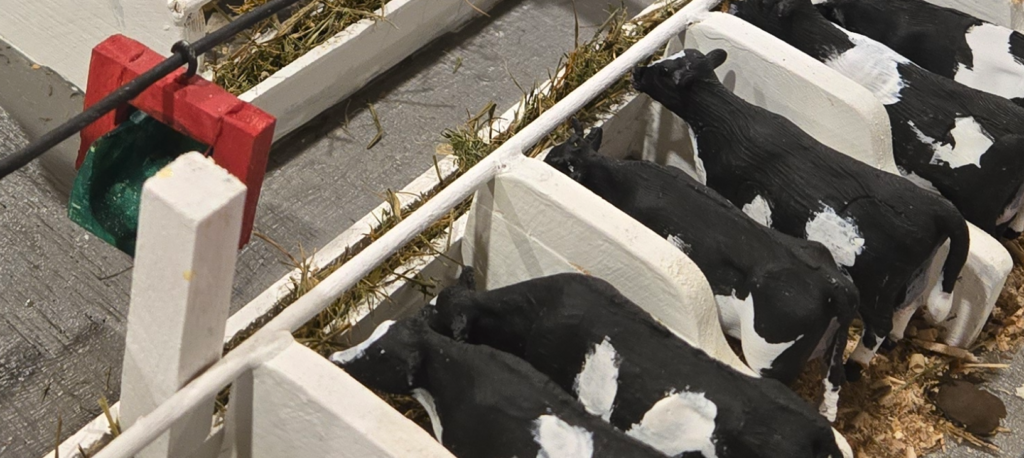
Roy remembers shovelling the stalls out to the litter carrier and, after dumping it into the manure pile out the back, they had to spread it out so that even the manure pile looked neat. Roy remembers that his grandfather always had the barn kept neat and clean, with attention to the details. Looking at the impressive model barn, one can see where Roy may have got that trait from.
There is real hay in the mow and in front of the animals, which is dried grass he collected from his neighbour’s lawn.
“Well, the horses have to eat something,” Roy says, with a smile.
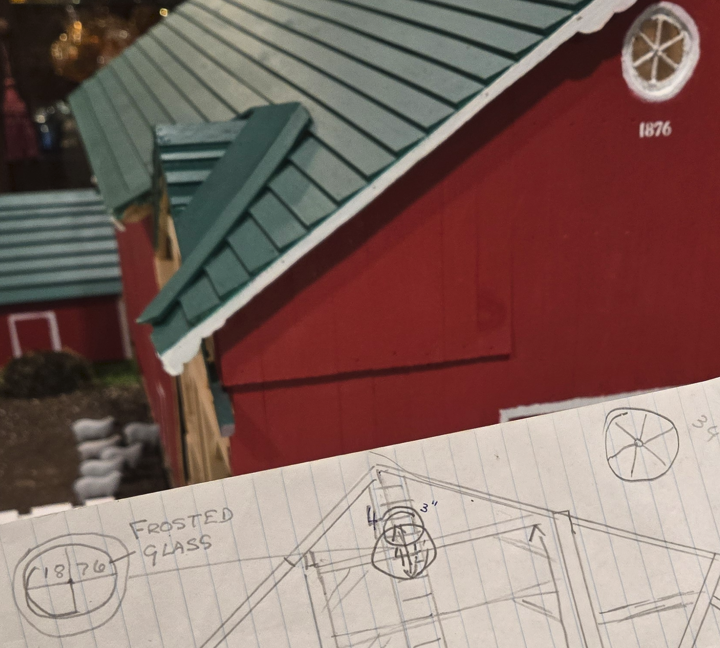
The buildings and the animals are mounted on plywood, with plastic turf and small trees to bring the scene to life. And it includes a model drive shed that his grandfather made for the family as a Christmas present in 1951. The whole scene brings Roy back to his childhood on his grandparent’s farm. He was fourth out of six boys and every time a new sibling was born, the rest of them would get a two-week vacation at the farm.
Roy’s parents had their own farm down the road, which had been bought originally by his paternal grandparents. Roy took over the farm and raised Aberdeen Angus, and his father moved the dairy herd to a larger farm down the road while one of his brothers bought another farm as well. The three farmed together until his brother and dad sold their farms. Only Roy was left managing his herd of beef cattle on the family farm where he was born. But after fifteen exhausting years, he asked his father how he would feel if he sold the home farm. His father wondered why he hadn’t thought of selling it earlier.
So, in 1975, Roy downsized to a 10-acre hobby farm with a few Charolais cattle, some chickens (the fancy ones, he adds), and there were ducks, geese, and guinea hens running all over the place. He had a pair of peacocks that he liked and raised a horse there, from a colt.
“It was a wonderful life there,” he says, but when the work commute to Kitchener got too much, he sold the property and moved to New Hamburg. The new owners of both the properties have taken great care of them, so he feels grateful about that.
Roy has an album of photos that document the project and have photos of his grandparents and the barn in its glory days. His great-grandfather was originally Johannas Junkblut, who was born in Germany and emigrated in 1856, married Maria Becker in 1871 and farmed on a 50-acre property in Ellice Township for nearly 30 years before he brought his family to the 150-acre property on the sixth concession of Wallace Township in 1900. His son was Fred W. Yungblut (by that time they had anglicised the last name) and he bought the farm in 1915, and his son Gordon bought it in 1961. Gordon’s son David bought it from his dad around 2006.
Roy regrets that his uncle Gordon didn’t live to see the completion of the model barn project. Gordon passed away in 2009, in his 90th year. He had come back from chores in the barn and told his wife, Grace, he wasn’t feeling well. By the time she brought him some tea, he was already gone, says Roy.
“What a way to go though,” says Roy, glad that his uncle did what he loved until the end. His tombstone in the Gowanstown cemetery is an impressive monument to his life on the farm, carved from a rock on the farm. (It is beautiful, I stopped in!)
As we put the barn back together, Roy is careful to lean the horses over because they are a bit too tall for the structure. “I broke one of the horse’s legs once, fortunately I was able to fix it and I didn’t have to put it down.”
In the basement, there is a room dedicated to shelves of Roy’s antique toy tractor collection. He has always loved history and loved collecting; he started collecting when he was 12 years old.
“Santa brought me this in 1952,” he says, as he points to a Massey Harris Model 44 tractor, still in great shape. “And six boys played with this one, if you can believe it.” That year, his brother also got a tractor, and his other brothers got some implements to pull with them. They all had to share and play with their toys like that, says Roy.
“And this was my first and last Cadillac,” he laughs as he holds a plastic yellow car. He remembers that the family would go to town once a week for meat and would get 25 cents as spending money. Roy found the Cadillac in the toy section of a Chainway store and when the clerk told him it was 75 cents, she offered to put it on layaway for him. Within the month, Roy had saved up his weekly spending money to buy the car. Six boys also played with it as well, and Roy made a few modifications to make a two-toned car with a vinyl top.
On the bottom shelf, he has a cardboard toy barn and the entire collection of cardboard farm animals on display. It was a learning toy from the 1930s, made by the Eaton company, and a booklet described the history and use of every animal on the farm.
Roy also has a collection of Ross Butler paintings. Butler was a local farmer and painter who made paintings of the “ultimate” of every breed of cow. Roy remembers that the paintings were above the blackboard in his one-room schoolhouse (and maybe every rural school) and that he just loved them.
He continues to work on history, currently working on family genealogies, from all four sides: the Berfelz and the Yungbluts, as well as the Nuhns and the Bradfords. He has photos of the families around the room, and he even has a trunk with items from his great grandparents. Inside is a black top hat in its original box and his great grandmother’s bloomers, elaborate and full of frills.
Roy celebrated his 80th birthday at the local community centre in early 2020 and there were over 250 names in the registry. It is easy to see why. Roy’s love for history and the family farm is infectious. He is so good-natured that I don’t want to leave.
Roy hopes that a museum will take his Yungblut model barn at some point so that many younger generations will get to experience what it was like for him growing up and working in that barn. ◊
To all OBP blog readers: If you have not already done so, please support not-for-profit, volunteer-run, Ontario Barn Preservation by becoming a member! Also, if you are in the business of repairing, reconstructing, engineering, designing, etc. old barns, please consider advertising your amazing skills on our Barn Specia-List. If you own an old barn that you would like to offer to someone else, or you are hoping to obtain one for your own project, make use of our Barn Exchange page. If you own an old barn and would like to save it in the virtual world for future old barn lovers, historians and researchers, check out our Your Old Barn Study page. And please send us your own barn story, photos and/or art for submission as a OBP blog posting for the enjoyment and education of all barn lovers! info@ontariobarnpreservation.com
Share this:

Discover more from Ontario Barn Preservation
Subscribe to get the latest posts sent to your email.